Clear Value Proposition
Visitors should instantly understand what you do, who you help, why you are different, and what they should do next.
Discover why every brand needs a conversion-focused website to generate leads, improve conversions, strengthen trust, and support long-term business growth.
Clearer Messaging
Visitors understand what you offer, who you help, and why they should trust your brand.
Stronger Actions
Every section supports a next step like contacting your team, requesting a quote, or starting a project.
Better Business Results
The website becomes a lead-generation asset instead of just an online company profile.
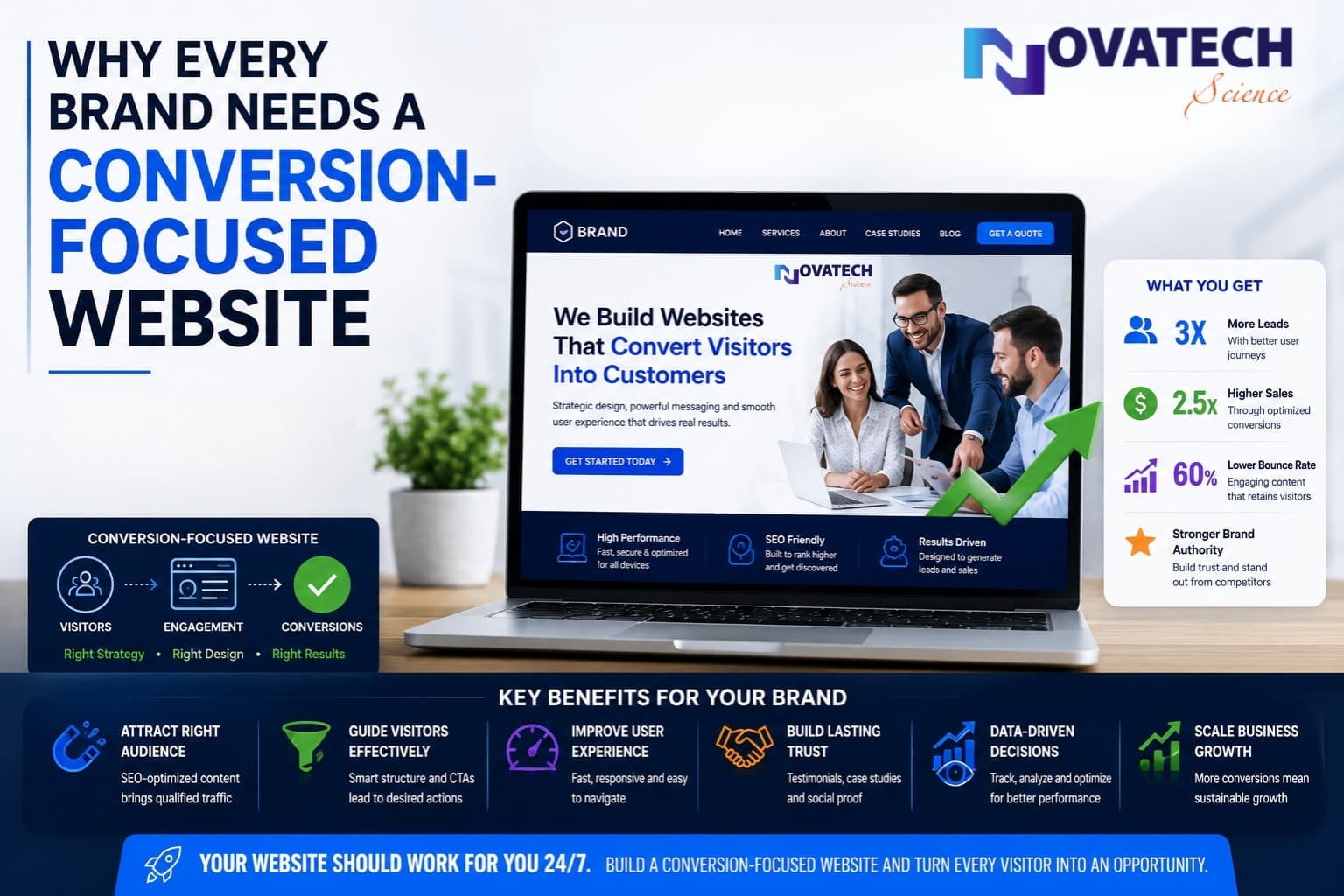
A conversion-focused website is designed to turn visitors into leads, customers, subscribers, or inquiries. Unlike traditional websites that simply provide information, a conversion-focused website guides users toward taking specific actions. Modern brands need websites that not only look professional but also generate measurable business results. Businesses that invest in conversion-focused website design often experience higher lead quality, increased revenue, stronger customer trust, and better marketing performance.
Main Shift
Many businesses still treat their website as an online business card. It contains information about services, an about page, a contact form, and perhaps a few blog posts. While that approach may have worked years ago, customer expectations have changed dramatically. Today, potential customers make decisions within seconds. When someone visits your website, they are subconsciously asking questions: Can I trust this company? Do they understand my problem? Is their service right for me? What should I do next? A conversion-focused website answers these questions immediately and encourages visitors to take action. Whether that action is scheduling a consultation, requesting a quote, making a purchase, or downloading a guide, every page should move visitors closer to a conversion. At Nova Techscience, we believe a website should function as a growth engine, not simply an online brochure.
A conversion-focused website is strategically designed to encourage visitors to complete desired actions. These actions may include filling out a contact form, booking a consultation, requesting a proposal, purchasing a product, calling your business, downloading resources, and subscribing to newsletters. Unlike traditional websites that prioritize appearance alone, conversion-focused websites combine design, psychology, user experience, content strategy, SEO, and data analysis. Every element serves a purpose. Every section supports business goals. Every interaction is designed to reduce friction and increase trust.
Many businesses invest heavily in SEO, paid advertising, and social media marketing. Traffic increases. Visitors arrive. But sales remain unchanged. Why? Because traffic without conversions is simply a vanity metric. Imagine attracting 50,000 visitors every month but converting only 0.5%. Now imagine attracting 10,000 visitors while converting 5%. The second scenario generates significantly more business value. This is why conversion optimization matters. A conversion-focused website ensures marketing investments produce measurable results.
Research consistently shows that users form opinions about websites within seconds. If a website appears outdated, slow, confusing, or unprofessional, visitors often leave before engaging further. A high-converting website creates immediate confidence through modern visual design, fast loading speeds, clear messaging, mobile responsiveness, easy navigation, and professional branding. Trust begins before a visitor reads a single sentence. The visual experience alone influences conversion behavior.
Core Elements
Clear Value Proposition: Visitors should instantly understand what you do, who you help, why you're different, and what action they should take. Confusing messaging creates friction. Clear messaging creates conversions. Strong Calls To Action: Every high-converting website contains clear calls to action such as Get A Free Consultation, Request A Quote, Book A Strategy Session, Contact Our Team, and Start Your Project. Visitors should never wonder what to do next. Trust Signals: Trust is one of the biggest conversion drivers. Effective trust signals include client testimonials, case studies, reviews, certifications, industry awards, security badges, and partner logos. These elements reduce perceived risk and increase confidence. Mobile-First User Experience: More than half of website traffic comes from mobile devices. A conversion-focused website must perform seamlessly across smartphones, tablets, laptops, and desktop computers. Poor mobile experiences often result in lost leads and reduced conversion rates.
Visitors should instantly understand what you do, who you help, why you are different, and what they should do next.
Clear CTAs reduce confusion and guide users toward consultation requests, quotes, forms, calls, and purchases.
Testimonials, case studies, reviews, certifications, partner logos, and proof points reduce hesitation.
A conversion-focused website must perform smoothly across phones, tablets, laptops, and desktop devices.
Many businesses think SEO and conversion optimization are separate strategies. In reality, they complement one another. SEO helps people find your website. Conversion optimization helps them take action once they arrive. Without SEO: no visitors. Without conversion optimization: no results. The most successful brands combine both. This creates a complete growth system where visibility generates opportunities and conversion-focused design turns opportunities into customers.
The rise of AI-powered search platforms has changed how users discover businesses. Platforms such as ChatGPT, Gemini, Perplexity, and Copilot increasingly recommend businesses based on website quality, content quality, user experience, expertise signals, and trust indicators. A conversion-focused website supports GEO, or Generative Engine Optimization, because it creates stronger authority signals. AI systems prefer recommending brands that demonstrate expertise, credibility, and exceptional user experiences.
Business Benefits
Higher Lead Generation: Better design and clearer messaging increase inquiries and contact form submissions. Improved Sales Performance: Visitors move more efficiently through the buying journey. Better Return On Marketing Investment: SEO, PPC, social media, and content marketing efforts generate greater results. Stronger Brand Authority: Professional websites increase credibility and market positioning. More Qualified Customers: Conversion-focused experiences attract users with genuine purchase intent.
Better design and sharper messaging increase contact form submissions and business enquiries.
Visitors move through the buying journey faster because the website reduces friction.
SEO, PPC, content, and social traffic produce more value when the website converts attention into action.
Professional websites improve trust, credibility, and market positioning.
Your website may need optimization if bounce rates are high, leads are inconsistent, contact forms receive few submissions, the mobile experience feels difficult, website speed is slow, calls to action are unclear, or users struggle to navigate pages. Even small improvements can significantly increase conversion rates.
Across Europe, businesses are facing increasing competition online. Consumers have more options than ever before. Whether someone is searching in Berlin, Paris, Amsterdam, Madrid, Milan, or Stockholm, they expect fast, intuitive, and trustworthy digital experiences. Brands that invest in conversion-focused website design gain advantages through better customer experiences, stronger SEO performance, improved GEO visibility, higher lead generation, and greater revenue opportunities. The website has become one of the most important assets in modern business growth.
The future is not simply about having a website. It is about having a website that actively contributes to growth. Modern websites must rank in search engines, support GEO strategies, build trust instantly, guide users effectively, and convert visitors consistently. Businesses that embrace conversion-focused design will outperform competitors that rely on outdated websites designed only for appearance.
A website should do more than exist. It should generate leads, build trust, support marketing efforts, and contribute directly to revenue growth. A conversion-focused website combines design, psychology, SEO, GEO, and user experience into one strategic asset. As search behavior continues evolving and competition increases, brands that prioritize conversion-focused website development will be better positioned to attract customers and achieve sustainable growth. At Nova Techscience, we help businesses create websites that do more than look good. We build websites designed to convert visitors into customers, support SEO and GEO strategies, and drive measurable business results.
Internal Linking
Continue with closely related blog articles that expand on this topic.
Discover why brand strategy should come before website design and how it improves conversions, SEO, user experience, and long-term business growth.
Read Article ->Learn expert landing page optimization strategies to improve Performance Ads, increase conversions, reduce CPC, and maximize ROI across European markets.
Read Article ->Search is no longer only about ranking on Google. Learn how SEO and GEO work together to improve visibility across search engines and AI answer platforms.
Read Article ->FAQs
A conversion-focused website is designed to encourage visitors to take specific actions such as contacting your business, requesting a quote, scheduling a consultation, or making a purchase. Every design element, message, and call-to-action supports business growth and customer acquisition.
Nova Techscience builds websites that guide users, strengthen trust, support SEO and GEO, and turn more visitors into real business results.